






Programme Course Name
MSc in Management (MiM)


Goods and Services Tax (GST) is a tax collected on behalf of Singapore Government and will be charged at the prevailing rate
Goods and Services Tax (GST) is a tax collected on behalf of Singapore Government and will be charged at the prevailing rate
Full-time (Jan Intake) - 1st: 30 Jun | 2nd: 31 Aug | Final: 31 Oct
Full-time (Aug Intake) - 1st: 31 Jan | 2nd: 31 Mar | Final: 31 May
Blended (Aug Intake) - 1st: 31 Jan | 2nd: 31 Mar | Final: 31 May
Bachelor's Degree / GMAT / GRE or SMU Admissions Test
No work experience required*
*We will accept a maximum of two years of work experience for the Full-time intake, and four years of work experience for the Blended intake.
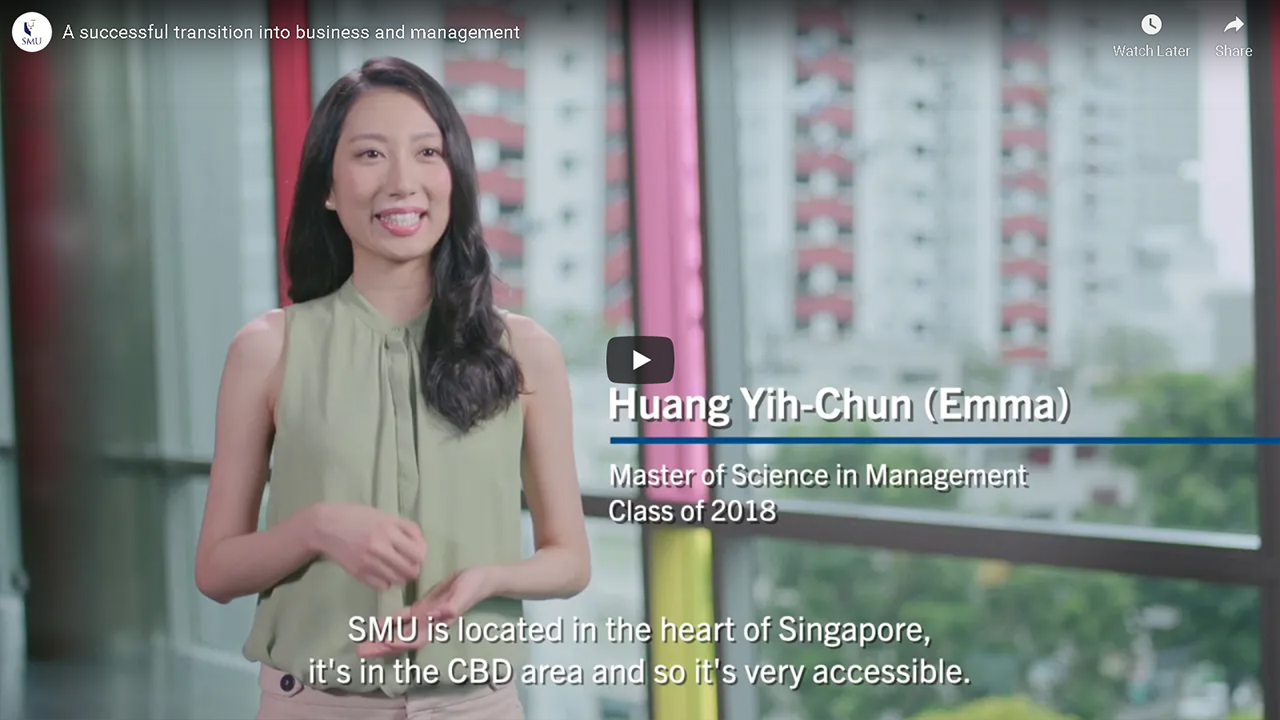
The SMU Master of Science in Management (MiM) programme is designed for individuals with no prior business experience to transit successfully to the world of business. With a comprehensive curriculum that covers the latest business trends, this programme offers you a broad but vigorous education in business management.
Improve your prospects with a well-balanced introduction to business and management, regardless of your academic degree and work experience. Develop a sound understanding of how a business operates, analyse the successes of today’s business empires and unlock your potential for career growth.
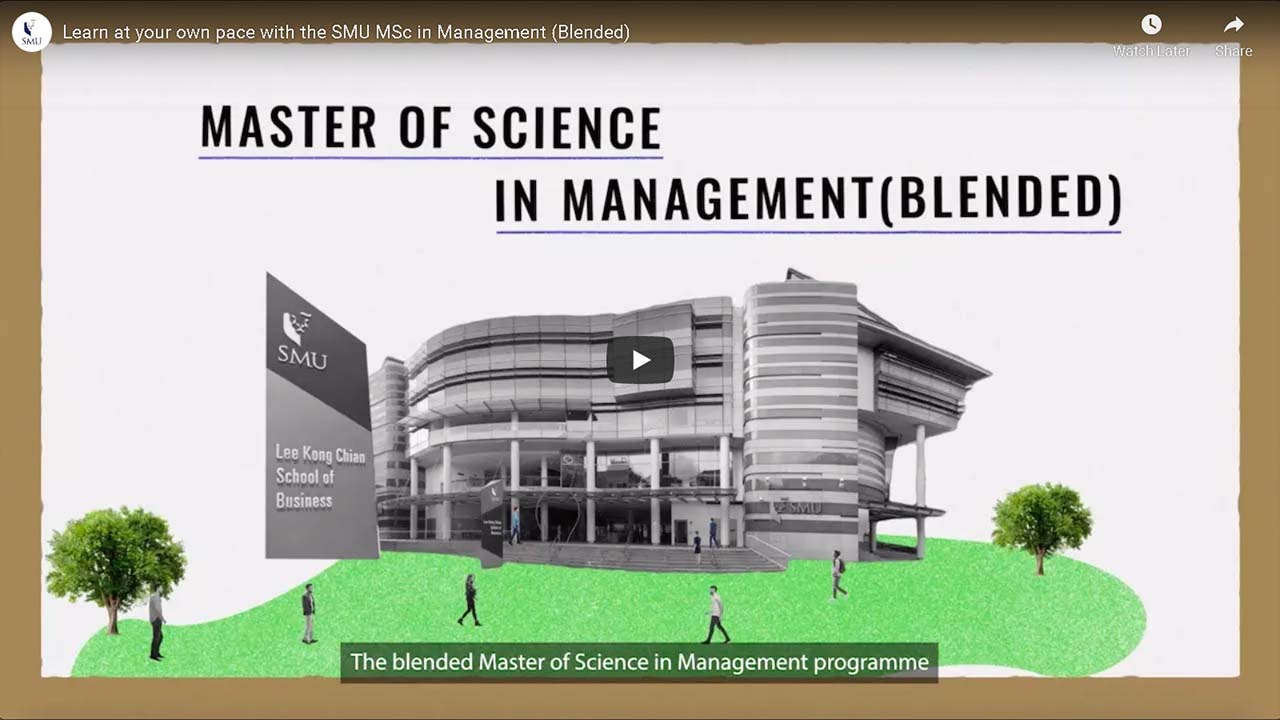
Dedicate yourself to studying full-time in Singapore or work and study wherever you are with the blended mode of study.
Gain global exposure through an exchange* at the London Business School or the Imperial College Business School in the United Kingdom, ESMT Berlin in Germany, or Smith School of Business at Queen’s University in Canada, or immerse yourself in the local culture in ASEAN countries via the Business Study Mission.
*Applicable for full-time students only.
Benefit from the combined experience and expertise of eminent, research-active faculty with PhDs from top-ranked universities and gain valuable insights from thought leaders in the industry.


















There are two intakes to the full-time mode of study of the MiM programme every year – January and August.
|
January |
|
|
August |
|
* PGDP = Postgraduate Professional Development
** Internship and Consulting Practicum
Programme Highlights:
Curriculum Overview
8 Core Modules
+
8 Elective Modules
|
General Elective |
|
|
General Elective |
|
Track-Specific Elective Modules
|
Modules offered in the Finance Track |
|
||
|
Modules offered in the Operations Management Track |
|
||
|
Modules offered in the Marketing Track |
|
||
|
Modules offered the Sustainability Track |
|
|
Modules offered in the Finance Track |
|
|
|
Modules offered in the Operations Management Track |
|
|
|
Modules offered in the Marketing Track |
|
|
|
Modules offered the Sustainability Track |
|
Modules offered are subject to change
This module introduces basic financial and managerial accounting topics aimed to give you an appreciation of financial statement construction as well as how accounting information is used by the various stakeholders both internal and external to your firm.
The module will enhance your technical skills in analysing business events and transactions, solving problems and cases, applying financial statement information to decision making and problem assignments. Hopefully, the knowledge gained will also facilitate personal decision making in your future everyday affairs.
The increasing availability of data is changing the way organisations think about themselves and the way they interact with the world. Data is helping improve the profits of businesses, the quality of life of individuals, the performance of sports teams, and social interactions. In this course, you will learn how to use data and analytics to assist in the decision-making process. The module will expose you to real-world examples of how descriptive, predictive, diagnostic and prescriptive analytics are used in various domains. Through these examples, you will learn how to use tools of analytics such as linear regression, logistic regression, classification and regression trees, random forests, clustering, matching, and optimisation, and visualisation techniques in practice. The statistical software R will be used in the course, and class demonstrations will be presented in R Notebooks. You are encouraged to create your homework and project reports using R Notebooks.
This module aims to provide you with fundamentally important ideas about what to look for in making good and informed investment, financing and dividend decisions. Our analysis will focus on how the right decisions can lead to the enhancement of your firm’s value.
In examining investment decisions, we will evaluate existing investments in terms of their fit to a firm’s overall strategy and economic value. To the extent that new investments are essential to the future growth and development of a firm, the assessment of new investments will be a critical area of study. We will also explore the various means of financing a firm, including the appropriate sources of funding in the various stages of development of a firm, the suitability of the vast array of financial instruments in the financial markets and the achievement of an optimal financing mix.
In essence, dividend decisions involve the determination of how much to reinvest and how much to return to shareholders. As such, we shall look at the impact of dividend policy to future growth and development of a firm, and the rationale behind the return of cash to shareholders.
The concepts of risk and returns, of options value and applications in corporate finance, and of how to balance off the risks versus returns in asset pricing models will be discussed. This trade-off is equivalent to finding optimal value or valuation of the opportunities that present themselves to corporate business. In addition, the module will also cover important valuation principles/methodologies, applications to mergers and acquisitions situations, and value enhancement models.
Your professional success in any complex organisation today depends not only on technical, functional and professional skills, but also on the ability to navigate the people side of organisations: to successfully work with and through others to achieve individual, group and organisational objectives. You will benefit from a deeper understanding of, and an ability to apply, a range of concepts and frameworks for managing people and organisations that this course provides.
This module introduces you to the theoretical concepts and analytical tools required for formulating and implementing appropriate strategies that affect the enduring success of the entire organisation. Topics covered include external and internal environmental analyses, business-level strategies, corporate-level strategies, strategy process and implementation, and special topics such as competitive dynamics and competition in high-tech industries. This module emphasises the application of theory to a number of real-world strategic issues. You are encouraged to synthesise knowledge from other business courses into a comprehensive understanding of corporate competitive advantages.
This module presents the design of new supply chains and the restructuring of existing supply chains to be sustainable and provide better value in a global context. We will analyse the design of innovative supply chains that provide firms with a strategic and sustainable competitive advantage and utilise global resources and markets.
This module should be of particular interest if you aspire to a career in designing and managing business processes, either directly (e.g., V.P. of Operations, Logistics Manager) or indirectly (e.g., management consulting). It will also be useful to entrepreneurs who intend to serve new markets, or use new technologies, or to those who wish to strategically reposition their offerings in an existing market. The module should also be of interest to those who manage interfaces between operations and other business functions such as finance, marketing, managerial accounting and human resources.
This module provides a broad but rigorous look at the international aspects of economics. It is divided into two sections: the microeconomic section with a focus on trade, and the macroeconomic section with a focus on international finance. The trade section establishes the foundations of comparative advantages and the benefits of trade, and assesses the issues of international policy concerning trade, including current contentions and controversies. The finance section looks at international payments and flows of money, the issue of surpluses and deficits and international policy concerning exchange rates and monetary regimes.
Successful firms are those that integrate the objectives and resources of the organisation with the needs and opportunities of the marketplace better than their competitors. They identify untapped sources of customer value, and deliver and capture more customer value than their competitors. The role of marketing management in organisations is to identify customers' unfulfilled desires, determine which customers the business should serve, decide on the appropriate products and services, and determine the optimal methods of pricing, promoting and distributing the products or services.
Using a country-specific study as its base, the ‘Business Study Mission’ module examines the rapidly developing business environment and the available opportunities in a particular city or region. Emphasis is placed on the socio-political, cultural and legal environments, and the influence they exert on business practices.
The competencies to communicate cross-culturally well are indispensable in this age of globalisation. This module looks at corporate culture and provides strategies on how to read a person. We will explore features of culture such as individualism/collectivism, power distance, masculinity/femininity, and issues related to intercultural adaptation, ethnocentrism, prejudice, stereotyping and racism. The aim of this module is to develop intercultural competencies, which will make business practices more meaningful and significant.
This module aims to help you instil and apply an entrepreneurial mindset in the context of business planning. We will achieve this through a number of ways including the generation of business ideas and the identification of business opportunities to commercialise those ideas. This module covers some ongoing management challenges for entrepreneurial ventures and integrates inter-disciplinary knowledge customised by your personal experiences and goals.
Professional success is largely dependent on success in managing differences and fostering collaboration among people and organisations. However, in today’s highly dynamic and complex managerial environment, which is marked by increasing interdependence and often by conflicts of interest, it can be extremely challenging to bring together the relevant “players” – internal and external stakeholders who have different interests, perceptions, attitudes, behaviours, or values – to forge efficient, profitable and lasting agreements. Professionals who understand the science and practice of negotiation are much better equipped to navigate these differences and create agreements that advance their own interests, and also the interests of the other parties involved.
This module will equip you with strategies to successfully communicate solutions to organisational problems. Since the course emphasises the importance of effective written and spoken communication within a business setting, you will be exposed to strategies that will enable you to communicate your ideas and values in a clear, persuasive and memorable way. You will, therefore, learn the art of producing impactful business documents and delivering engaging presentations in various business contexts. By the end of the module, you will be able to function as proficient communicators who are ready to embrace the communicative challenges inherent in today’s dynamic business environment.
This module introduces you to new venture creation and design thinking tools for identifying new and better ways of providing products and services that meet customer expectations. In Part 1, the opportunity recognition process is introduced. We will look at how external factors (context, available resources) and intrinsic factors (motivation, network, risk propensity) interact to create opportunities that an entrepreneur then chooses to seize.
In Part 2, the qualitative design thinking process (based on the IDEO/Stanford Design School process) is introduced (empathise, define, ideate, prototype, test). We will discuss applications of design thinking to product and service innovation, along with variations in design contexts, including the private sector, government and social sectors. You will learn to think like an innovator, from the initial idea to managing resources, building partnerships with committed stakeholders and dealing with contingencies. In parallel, you are encouraged to consider your individual accomplishments and how these might support new venture creation. You will work on past accomplishments, gaining the skills, knowledge and abilities that create a unique set of means by which to drive your own innovation projects.
This module focuses on the role of financial markets in facilitating the flow of funds to finance investments by corporations and governments. It builds on the foundations provided by FNCE680 Corporate Finance & Financial Management and our focus will be to understand how financial markets work practically. We will systematically examine equity, debt, foreign exchange, derivative, real estate and insurance markets and describe the participants and types of instruments offered. We will learn how and whether one should invest or participate in each of the different markets and also examine the role of financial institutions such as commercial banks and mutual funds.
This module is a blend of theory and practice that begins by describing the investment environment, developments in investment theory, and the principles and practices of valuation. The focus is on the analysis of equities and equity portfolio management. The topics covered include the valuation of companies, stock valuation, the portfolio investment process, asset allocation, portfolio construction and portfolio performance evaluation. Throughout the course, we will place emphasis on a global perspective.
This module aims to provide you with insights into the role of the investment banking industry in facilitating the raising of capital for corporations, in the equity and debt, or mergers & acquisition (M&A) markets, to assist a corporation to grow. The structure of investment banks and how each division inter-relate, will be discussed, e.g. corporate finance, Equity Capital Market (ECM), Debt Capital Market (DCM), Sales & Trading, Operations, Global Markets, Compliance, etc. You will learn about how primary market deals relating to equity, debt and M&A are structured to maximise share value, as well as how these are skilfully executed to ensure that values are preserved and achieved. You will also be taught about the fundamentals of valuation as well as the best practices in financial modelling. This module is not only useful for future investment bankers but also for those interested in learning about raising capital in corporations.
This module aims to provide you with an advanced study of Corporate Finance beyond the essentials. You will be exposed to complex financial issues and be equipped with the necessary analytical tools to make sound financial decisions. The module covers a wide spectrum of topics such as optimal capital structure, mergers & acquisitions, pay-out policy and corporate restructuring . It will focus on understanding core financial tools that help managers understand strategic and tactical financial problems, developing the linkage between corporate financial decisions and value creation in firms and providing a framework to help managers make optimal financial decisions.
The objective of this module is to introduce Decision Analysis, which is the application of the scientific method to managerial and personal decision-making. The decision analysis approach of analysing decisions consists of defining a problem, developing a model, acquiring data, developing and testing a solution, and analysing and implementing results. Decision models can be categorised as Prescriptive, Predictive and Descriptive. This module will discuss some Prescriptive and Descriptive models, particularly quantitative modelling tools such as linear and integer programming, decision tree analysis and simulation.
With the globalisation of operations and the penetration of technology into virtually every business activity, projects are becoming more and more challenging and demanding. Increasingly complex products, processes and services, vastly shortened time-to-market windows, and the need for cross-functional expertise make project management an important skill for success. Project management aims to improve an organisation’s ability to plan activities and control the ways in which it utilises resources, and minimises risks. Professionals launching and managing these projects must understand the concepts, methods, techniques and tools that support modern project management, covering project selection, initiation, planning, implementation, control and evaluation. The participants will get hands-on experience with state-of-the-art software tools for project and project portfolio management.
A supply chain comprises firms, organisations, and individuals, linked through physical (material), information and financial flows, and whose activities enable products and services to be created and reach consumers. In the last few decades, supply chain managers have reoriented their focus beyond the traditional logistics issues towards the development of integrated risk management approaches to handle the multiplicity and magnitude of risk factors in global supply chains. These risk factors include disruptions arising from natural and man-made disasters, fast-changing customer preferences, tight financial credit environments and fluctuating exchange rates and commodity prices. Building a functional supply chain requires careful planning and consideration of a variety of risks, and it is of paramount importance to integrate management of physical flows, information and financial flows in dealing with such risks. All logistics and supply chain organisations that effectively manage their supply chain risks enjoy a level of robustness and resilience that leads to unprecedented levels of operational excellence with all consequential advantages. The objective of this module is to provide you a framework for supply chain risk management and to outline a portfolio of proven strategies to access, reduce, hedge and mitigate supply chain risks.
With the convenience of the Internet at our fingertips, e-commerce has grown into a huge industry and the world of business is changing rapidly beyond brick and mortar. Customers not only shop through different retail channels - in store, on the web and on mobile devices, but also expect a consistent buying experience across these channels. This creates a host of new business models, such as marketplaces and omni-channel retailing, that require new sets of skills to manage. The objective of this module is to provide you with these necessary skills. Topics that will be discussed include online retailing, marketplaces, logistics and technologies, omni-channel retailing, consumer analytics and the sharing economy.
Understanding consumers is at the heart of a successful marketing process. Methods of generating consumer insights such as in-depth interviews and focus groups, ethnography, survey research, systematic observational research and experiments are key to diagnosing both the current status of a market as well as the issues underlying a specific marketing challenge. The course will cover a variety of these methods of generating consumer insights as well as the statistical methods used to analyse survey data.
You will learn how to use insights generated to address marketing issues such as uncovering consumer needs, segmentation, product design, pricing structure and evaluation of promotions. The module will be taught using a combination of lectures, case discussions, in-class workshops, guest lectures and a group project. If you wish to work in consulting or in branding/marketing/advertising in B2C organisations, you will find this module particularly useful.
The study of consumer behaviour is an important part of the science underlying the development of marketing programmes. Consumer behaviour is a natural extension of the application of the marketing concept that prefaces the study of marketing. Consumer research is a prelude to the formulation of marketing programmes. This module introduces important theories, methods and findings of research on attention, comprehension, memory, attitude formation and choice.
This module is designed to meet the increasing needs of industry and recruiters in applying quantitative and analytical skills for understanding consumer decision-making. Business managers use marketing data to assess the return on their investments and better understand their customers. The module gives you an opportunity to analyse real-world marketing problems and learn through “hands-on” experience. We will use developments in statistical science to examine solutions to important issues faced in consumer analytics. There will be various datasets and tools provided and used in the class to get practical experience. Specifically, we will discuss market and customer segmentation techniques, regression and choice modelling, economic models of pricing, retail and web analytics, with the emphasis being on understanding, interpreting and the proper use of these research techniques. The primary aim of this module is to learn new skills and tools that will allow you to develop important quantitative acumen for understanding consumer analytics.
The world of commerce is going rapidly beyond brick and mortar, and is increasingly relying on digital technology. Today, customers expect a consistent buying experience across all retail channels - in store, on the web and on mobile devices. This leads to a host of business models that require or can benefit from new functional expertise and processes. The objective of this module is to provide you with the necessary skills to evaluate the changing business world and identify opportunities to harness and optimise businesses through digital technology. The module focusses discussion around digital business and covers aspects relating to business strategies, digital business supply chains, fulfilment technology and innovations, technology leverage for management and consumer insights. The module consists of two parts covered over four weeks each: (i) business strategies and operational challenges for digital business and (ii) the applications of consumer analytics to digital business.
This module examines the terms and meanings of sustainability, including their origins. It discusses the linkages between sustainability and other society challenges and helps you understand how business and society interact within the natural environment. You will learn how to distinguish between effective and rhetorical sustainability strategies. Topics covered in the module include Global Environmental Issues, Origins of Sustainability Thinking, Systems Thinking, Triple Bottom Line, Green Value Chain, IT and Sustainability and Strategic Sustainability.
This module provides you with foundational knowledge and techniques on how to embed sustainability into business operations. You will learn how firms develop effective programmes and strategies in waste reduction, pollution prevention and product stewardship. Topics covered include Ecologically Sustainable Organisation (ESO), Environmental Regulations and Incentives, Environmental Management Systems, Sustainable Supply-Chain Management, Green Purchasing, Green Buildings, Life Cycle Analysis, Product Stewardship, Remanufacturing and Recycling, Industrial Symbiosis and Green Technology.
This module introduces you to a plethora of standards, metrics and reporting requirements to evaluate organisational sustainability performance. You will develop insights on the various approaches to sustainability and make good judgements on the range of standards and goals to evaluate sustainability performance. Topics covered in the module include Financial and Economic Capital, Environmental Sustainability and Natural Capital, Social Sustainability and Social Capital, Environmental Partnerships, Corporate Social Reporting and Disclosure, Environmental Auditing, and Corporate Sustainability Assessment and Financial Performance.
This module helps you understand how sustainability challenges pose risks and opportunities to businesses and investors. It exposes you to emerging theories and practices on how businesses and investors can apply finance to manage sustainability risks and opportunities. You will also learn how to frame managerial and investment objectives that are consistent with business sustainability. Topics covered in the module include Socially Responsible and Impact Investing, Microfinance, Responsible Lending, Green Finance, Climate Change and Finance Implication, and Corporate Social Responsibility (CSR) and Firm Performance.
The blended MiM programme is delivered primarily online, with a mixture of on-demand and live sessions and supplemented by four face-to-face, on-campus segments.
|
Team |
Module |
|
|
Aug - Dec |
Accounting |
Marketing Management |
|
Jan - Apr |
Operations Management |
Business Analytics |
|
Apr - Jun |
Corporate Finance |
Managing People & Organisations |
|
Jul** |
Negotiation in Business* |
|
|
Aug - Nov |
Strategic Management |
Global Economics |
|
Nov |
Supply Chain Management |
|
|
Jan - Mar |
Digital Marketing |
Business Acceleration & Growth Strategy |
|
Apr - Jun |
Doing Business in Asia |
Human Capital & Business Strategy |
*Denotes compulsory elective
**Denotes campus segments
Graduation requirements of 15 credit units includes 8 core modules, 1 university core, 4 electives and 2 open modules
Curriculum Overview
|
8 Core Modules |
8 Elective Modules |
|
Accounting |
Business Acceleration & Growth Strategy |
|
Business Analytics |
Communication Management |
|
Corporate Finance |
Digital Marketing |
|
Global Economics |
Doing Business in Asia |
|
Managing People & Organisations |
Financial Management in Practice |
|
Marketing Management |
Human Capital & Business Strategy |
|
Operations Management |
Negotiating in Business (Compressed Module) |
|
Strategic Management |
Supply Chain Management |
Modules offered are subject to change.
Accounting is the language of business. An understanding of the preparation, presentation and analysis of financial statements in crucial to anyone who has to work with financial information and make financial decisions. This course equips you with the fundamental aspects of financial and management accounting. It enables you to understand how accounting information is used by various stakeholders both internal and external to the organisation. Specifically, you will learn the basic concepts and principles underlying the accounting process, elements of financial statements and analysis of financial statements. In addition, coverage of costing, budget and planning provides you tools to manage business operations.
This module is designed to meet the increasing needs of industry and recruiters in applying quantitative and analytical skills for understanding consumer decision-making. Business managers use data to assess the return on their investments and better understand their customers. This course provides you with an opportunity to analyse real-world business problems and you will learn through “hands-on” experience. We will use developments in statistical science to examine solutions to important issues faced in business analytics. There will be various data sets and tools provided and used in the class to get practical experience. Specifically, we will discuss market and customer segmentation techniques, linear regression and logistic regression, economic models of pricing, retail and web analytics. The emphasis being on understanding, interpreting and proper use of these research techniques. The statistical software R will be used in the course and the primary aim of this module is to learn new skills and tools that will allow you to develop important quantitative acumen for understanding business analytics.
Finance is about the allocation of capital for productive use in the economy. In this module, we examine how financial assets are priced (asset pricing) and how firms raise capital (corporate finance). In the asset pricing portion in the first half, you will learn about the importance of finance in society, get familiar with tools that are necessary in finance such as the time value of money and apply these tools to the pricing of bonds and stocks. Finally, you will learn about the fundamental concepts of risk and return, and portfolio theory, and how these relate to investing. The segment on Corporate finance (the second half) is about financial decision-making in a firm with the objective of maximising the firm’s value. The key corporate finance decisions can be grouped into three types: investment decisions, financing decisions and dividends decisions. This segment aims to provide you with fundamentally important ideas about what to look for in making good decisions from a corporate manager’s perspective.
One’s professional success in the complex organisations of today depends not only on technical, functional and professional skills, but also on the ability to navigate the people side of organisations: to successfully work with and through others to achieve individual, group and organisational objectives. You will benefit from a deeper understanding of, and an ability to apply, a range of concepts and frameworks for managing people and organisations. This module aims to provide such understanding and ability.
This module introduces you to the theoretical concepts and analytical tools required for formulating and implementing appropriate strategies that affect the enduring success of the entire organisation. Topics covered include external and internal environmental analysis, business-level strategies, corporate-level strategies, strategy process and implementation, and special topics such as competitive dynamics and competition in high-tech industries. This module emphasises the application of theory to a number of real-world strategic issues. You are encouraged to synthesise knowledge from other business courses into a comprehensive understanding of corporate competitive advantages.
To increase competitiveness and maintain profitability, companies need to manage their operations successfully. Operations management deals with the organisation of business processes to control resource usage and costs while ensuring quality and timely product or service delivery. This module introduces process design and analysis to improve service levels, reduce inventory and waiting times, and ultimately improve revenues and profits. It provides an introduction to supply chain management and illustrates how innovative supply chain design, from shortening of lead time to cooperation and location decisions, can offer a competitive advantage. Throughout the module, we will explore the concept of sustainability in operations and discuss how to build sustainable processes that benefit the triple bottom line (people, planet, profit).
This module provides a broad but rigorous look at the international aspects of economics. It is divided into two sections: micro and macro. The microeconomics section first establishes the behaviour of consumers and firms, demand and supply, and pricing under different market settings, before taking on international trade models. The macro section first covers national output and balance-of-payments accounting, factors affecting economic growth, and the money market, before moving onto models of exchange rate determination. Throughout the module, real-world, practical examples will be emphasised.
Successful firms are those that integrate the objectives and resources of the organisation with the needs and opportunities of the marketplace better than their competitors. They identify untapped sources of customer value, and deliver and capture more customer value than their competitors. The role of marketing management in organisations is to identify customers' unfulfilled desires, determine which customers the business should serve, decide on the appropriate products and services, and determine the optimal methods of pricing, promoting and distributing the products or services.
This introductory course is designed to provide a broad overview of critical dimensions of human capital in the context of business strategy. Human Resource professionals and organisational leaders must understand the context of the organisational environment and make decisions related to human capital. Starting with the origins of the concept of human capital, we explore the direct and indirect influences of organisation structure, strategic leadership, organisation culture, and talent management on human capital as a resource of the firm.
This module introduces students to core concepts in business acceleration and how these translate to growth in entrepreneurial ventures. We systematically explore how firms grow their business and the challenges they face in doing so. The module includes components from across multiple disciplines of strategy, marketing, finance and human resources to solve daily challenges of growth, and is designed to help you rethink the tenets of core strategy in an entrepreneurial way. The module will be centred around case discussions, with short assignments to be written on different cases.
This module serves as an introduction to the secretive, fascinating and high-octane world of hedge funds. The aim is to provide you with an understanding of the various hedge fund strategies and the risks that they are exposed to. By understanding the investment issues, agency problems and operational constraints that hedge funds grapple with, you will be equipped with the skills to select hedge fund products. The module will be useful for aspiring chief investment officers, asset managers, private bankers, family office managers, prime brokers at investment banks, hedge fund managers and hedge fund investors.
This module aims to provide you with an advanced study of Corporate Finance beyond the essentials. You will be exposed to complex financial issues and be equipped with the necessary analytical tools to make sound financial decisions. The module covers a wide spectrum of topics such as optimal capital structure, sources of financing, pay-out policy, mergers & acquisitions and corporate restructuring . It will focus on providing a theory framework to understand how managers make optimal financial decisions, mastering core financial tools that help managers deal with strategic and tactical financial problems and developing the linkage between corporate financial decisions and value creation in firms.
The world of commerce is growing rapidly beyond brick and mortar, and is increasingly relying on digital technology. Today, customers expect a consistent buying experience across all retail channels - in store, on the web and on mobile devices. This leads to a host of new (semi-) digital business models. The objective of this module is to provide you with the necessary skills to evaluate the changing business world and identify and act on opportunities to strengthen businesses through digital marketing technology. The module introduces you to the various digital business models, content and social media marketing, search engine optimisation, online advertising and digital direct marketing. Moreover, you will be equipped with the skills required for measuring and evaluating digital marketing investments and will learn about the importance of privacy in the context of digital marketing. The module will be an eight-week elective.
This module aims to examine a range of topics pertinent to communication management in an age of disruption. With the world of business constantly changing, this course combines fundamental theoretical concepts with practical guidelines and cases. By the end of the course, students will be able to function as proficient communicators who are ready to embrace the communicative challenges inherent in today’s dynamic business environment.

| INTAKE | APPLICATION DEADLINES |
|
January |
**Application opens 1 June** Round 1: 30 June Round 2: 31 August Round 3: 31 October |
|
August |
**Application opens 1 December** Round 1: 31 January Round 2: 31 March Round 3: 31 May |
|
Blended |
**Application opens 1 July** Round 1: 31 January Round 2: 31 March Round 3: 31 May |
We encourage candidates to complete their applications in earlier deadlines, as seats in the MiM programme and scholarships may be limited by Deadline 3.
We typically receive an influx of applications near deadlines. To reduce the stress of meeting our application deadlines, which includes collating relevant documents and waiting for your referee reports, we encourage you to start your application as soon as you can.
While filling in your application, take note that you will be required to submit the following:
| TESTS | INSTITUTION CODES |
|
GMAT |
F8D-7V-25 |
|
GRE |
2861 |
|
TOEFL |
9014 |
Two referee reports are required for admission to the MiM programme. You are required to submit two complete sets of referee details during the online application.
These referees can be from your current or previous employer, a colleague, or someone who knows you well at work, OR from someone who has taught you at university or college.
Once you submit the online application, an auto-generated email will be sent to your referees via the email address you have entered. Your referees will then be able to click on the url in the email to fill in an online referee form for you. This will take 5-10 minutes to complete. Please ensure that your referees' email addresses are correct. Alternatively, if you have on hand a reference letter from your referees, you can also send them to us in softcopy format. In that case, you can request your referees to ignore the auto-generated email sent.
Once you have submitted your application and have received the application number confirmation email, you can use the Applicant Self Service functions to check your application status or update your contact information.
Please refer to the Applicant's Self Service Guide.
Full-Time Intake & Blended Intake
*SMU will accept a maximum of two years of work experience for the Full-time intake, and four years of work experience for the Blended intake.
**SMU undergraduate alumni with cumulative GPAs of 3.4 or better can use their undergraduate GPAs in place of the SMU admissions test. An undergraduate GPA is valid for five years after graduation.
The full-time mode of study of the MiM programme is open to all Singaporeans and Singapore Permanent Residents (PR). It is also open to international students who hold a valid Employment Pass or Dependant’s Pass, and do not require a student visa.
International students without a valid Employment Pass or Dependant’s Pass must possess a valid Student Pass to be able to study at SMU. SMU will assist in the application of student passes for all international students coming to SMU.
The blended mode of study of the MiM programme is open to all local and international students. International students will be required to travel to Singapore for the face-to-face segments.
Want to Know If You are Eligible for the Programme?
If you would like us to assess your suitability for the MiM programme, please deposit your resume here and we will contact you shortly.
|
Application Fee* |
Registration Fee* |
Tuition Fees for AY 2023 |
|
S$100 inclusive of GST |
Amount payable upon acceptance to the programme |
Full Time Programme:
Blended Programme: Fees are subject to change from year to year |
|
Application Fee* |
|
S$100 inclusive of GST |
|
Registration Fee* |
Amount payable upon acceptance to the programme |
|
Tuition Fees for AY 2023 |
|
Full Time Programme:
Blended Programme: Fees are subject to change from year to year |
*All fees are non-refundable and non-transferable. A initial deposit of $5,000 would be required upon acceptance of offer into the programme. The remaining tuition fees would be billed thrice over the duration of the programme. The fees are due and payable within 30 days of the billing. The tuition fee does not include meals, air travel, travel insurance, living and accommodation expenses incurred for the overseas exchange. Singapore Management University reserves the right to alter tuition and other fees as deemed appropriate. SMU alumni will be entitled to a 10% discount off the tuition fee. GST will still apply for the discounted tuition fee.
*Goods and Services Tax (GST) is a tax collected on behalf of the Singapore Government and will be charged at the prevailing rate.
AGL Irudayaraj Scholarship | Ayala Postgraduate Scholarship | Academic Excellence* | Global Awareness* | Leadership Potential | Community Impact | Impact on Asia | Women in Business
*All candidates are automatically submitted for consideration for Academic Excellence and Global Awareness scholarships upon meeting the scholarship criteria.
Partial scholarships for the Master of Science in Management (MiM) programme entail award amounts up to 30% of the tuition fee, with no bonds attached. 7% GST will still apply for the full tuition fee before the scholarship award.
The AGL Irudayaraj Scholarship is established by Professor Gerard George (Donor), Dean at the Lee Kong Chian School of Business at SMU, and his wife Mrs. Hema George. The Scholarship is named in honour of Professor George’s father-in-law who passed away in 2018. Mr AGL Irudayaraj was an entrepreneur and a champion for underprivileged Tamil Christian minorities in India, helping them in his own big and small ways. The scholarship is a tribute to his kind, selfless and enduring efforts in helping others towards a better life.
The purpose of the AGL Irudayaraj Scholarship is to motivate outstanding postgraduates of Indian ethnicity at the University to greater heights of academic excellence.
The Admissions Scholarship Committee will assess the following:
The Ayala Postgraduate Scholarship (valued at S$25,000) was established by the Ayala Foundation Inc. to encourage and motivate outstanding candidates from the Philippines in pursuing their postgraduate education. The Donor is committed to transforming the lives of the citizens of the Philippines through high-quality education. To do so, the Foundation has established the Ayala Postgraduate Scholarship at SMU, signifying support for the University's programmes.
Eligibility criteria:
The SMU MiM programme will offer the Academic Excellence Award to high-quality candidates with exceptional academic performance. Awards are based on academic merit, final grades and GMAT score.
SMU MiM programme is committed to crafting a very diverse and global academic environment that will contribute to the student’s personal and professional journey. The Global Awareness Award is given to individuals who will contribute to classroom diversity and enrich the learning experience of students by way of their cultural, personal or professional background.
The SMU MiM programme recognises individuals with strong leadership potential who have exhibited outstanding leadership potential during their studies, community or organisation with a Leadership Potential Award. Applicants must demonstrate strong leadership potential in personal and professional instances.
The Admissions Scholarship Committee will assess the following:
LKCSB nurtures keen minds profoundly committed to leaving a positive impact on their community. The “Community Impact Award” recognises candidates who have contributed to society through outstanding community work (e.g. voluntarism, social, non-paid work, etc.) and have impacted, through their actions, members of the community / society in a positive manner.
The Admissions Scholarship Committee will assess the following:
The SMU MiM programme is creating a significant impact in Singapore, extending now to Asia. We look forward to welcoming students who can demonstrate achievements in their professional, social and personal life that have created an impact on Asia, such as:
The Admissions Scholarship Committee will assess the following:
With the Women in Business Award, the SMU MiM programme aims to recognise exceptional women who have demonstrated outstanding leadership capabilities or potential in their professional or personal endeavours. Applicants must have successfully received an admissions offer.
The Admissions Scholarship Committee will assess the following:
The LKCSB Financial Aid Bursary enables suitable MiM candidates to obtain financial support from the Admissions Scholarships Committee to further their business studies with the SMU MiM programme. Candidates will have to provide supporting documents to prove financial need.
SMU is committed to lifelong learning. Graduates from SMU undergraduate or postgraduate programmes are automatically eligible for a discount of 10% when applying to the MiM programme.
This loan carries a low interest rate of 3.02% p.a. For more information, please call 6333 7777.
For enquiry on this, please contact:
Yvonne Tan
Contact details: 9646 8808 / (65) 6661 2157
Email: Yvonnesg.tan@cimb.com
This study assistance loan carries an interest rate of 4.60% p.a. For more information please call 6333 0033.
The application must be with a joint applicant who is a Singaporean or Singapore PR.
For enquiry, please contact:
Cheong Yu Shan / Sandy Chenxu,
Direct Sales Management, Community Financial Services
DID: (65) 9691 5134 / 9221 5148
Email: yscheong@maybank.com.sg / wpchenxu@maybank.com.sg
For more information please call +65 6595 9723.
For more information,please call 1 800 363 3333.
SBI provides student loans exclusively for students from India who have secured admission in selected educational institutions for higher studies in Singapore. Your loan is secured against a Standby Letter of Credit (SBLC) issued by SBI branch in India, backed by mortgage of property or cash deposits in India.
For enquiry, please email: studentloan@sbising.com

The Master of Science in Management is a programme designed for those who would like to pursue a postgraduate management degree prior to embarking on a career. It is intended to appeal to students with limited or no previous business experience who are seeking a well-rounded orientation to business management. Students will develop business and management skills, enhance employment versatility in the workplace and possess the knowledge needed to be successful in today’s global environment. Even if there is no intent to pursue a career in any of the business sectors, the programme will equip students with a good understanding and overview of how a business operates and integrates its key functions. In addition, the programme is suitable for those who intend to start their own businesses in the future as it covers all aspects of managing a business enterprise.
SMU has earned accreditation from the most established global accrediting body, AACSB International (AACSB) for both its business and accounting undergraduate and postgraduate programmes. As the hallmark of excellence in business education, AACSB accreditation has been earned by less than five per cent of the world’s business schools. In addition, SMU is pleased to be one of the few Asian universities to receive a five-year EQUIS accreditation.
Both programmes are designed differently for different purposes. The MiM programme is designed to immerse students in core business fundamentals and develop them into well-rounded individuals who are able to understand how companies run their businesses. The programme also widens their career options beyond their main area of expertise, and is suitable for individuals who would like a comprehensive overview on business and management principles.
The MBA is designed for those with sufficient work experience, and provides the option for students to choose to specialise in the field of Management, Marketing, or Finance through its 10 electives.
The programme is designed as a graduate management programme and would be of interest to those who desire to move into supervisory and management positions in a wide variety of industries in the future. As such, SMU MiM graduates will be able to explore various career options in different business sectors such as logistics, shipping, healthcare, manufacturing, government and non-profit organisations. The programme will equip students with a good understanding and overview of how a business operates and integrates its key functions. In addition, the programme is suitable for those who intend to start their own businesses in the future as it covers all aspects of running a business.
No, this is optional. The concentration tracks on offer right now are: i) Marketing, ii) Finance, iii) Operations Management & iv) Sustainability
If you have a clear idea of your career plans, a concentration can help show your emphasis to employers. Please be advised that you are required to choose your tracks by the end of Term 2.
It will not reflect on your degree scroll, but will be noted on your transcript.
No, each student may elect one concentration area.
There will not be other concentration areas offered at this time.
If you want to change your mind later, you would require prior approval from the Academic Director of the Programme, before Term 3 commences.
The upcoming intake is a full-time, 18-month programme.
We have two intakes per year - one in January and one in August.
Yes, examinations will be applicable for certain modules such as corporate finance and accounting for managers. The rest of the modules will comprise a range of assessment methods including but not limited to class presentation, case studies, quizzes and group projects.
This programme is open to all nationalities. SMU will assist foreign students to apply for the Student Visa. Please note that both local and foreign students pay the same tuition fees.
We welcome applicants from candidates with a good Bachelor’s degree regardless of previous background or experience. Additionally, you are required to submit your results for GMAT or GRE and show a proficiency in English language or a good TOEFL/IELTS score. If you do not have a GMAT score, you can opt to do the online SMU Admission Test. Shortlisted candidates will need to go through a face-to-face or telephone interview.
The Kira Talent Video Interview is a recorded video interview designed for our Admissions Committee to virtually meet you and to get a good sense of your personality, potential, and ability to think on your feet. It will serve as a screening tool that complements the rest of your application process. The invitation to complete your interview will be sent to you as an automated email message from no-reply@kiratalent.com once you submit your online application form. You will have to access the email and follow the instructions within in order to proceed with your application process. More information on the interview process can be found in this factsheet.
Part of the admission requirement for this programme requires either GMAT or SMU Admission Test. If you have not taken the GMAT test, you may wish to consider taking the SMU Admission Test. It is an online test comprising of 3 components: verbal, numerical, and inductive reasoning. All 3 components will take approximately 1.5 hrs to complete. To opt for the SMU Admission Test, you will need to make a payment of S$125 on top of the application fee of S$100 so we can release the test details to you.
We consider a GMAT score of 600 and above to be competitive for admission consideration. For SMU Admission Test, a T-Score of 55/80 would be competitive.
No. This programme is recommended for individuals with little to no work experience.
All applicants pay the same tuition fee.
There are a range of scholarships available for the programme, and you can learn more about them above.
Under the Productivity & Innovation Credits (PIC) scheme, the Singapore government is offering companies tax incentives of up to 400% tax deductions/ allowances for training employees. Please visit www.iras.gov.sg for more information.
Career counselling and workshops will be provided to MiM students and attendance is compulsory. SMU’s career services are designed to improve our students’ chances of securing their desired employment upon completion of the programme. Our MiM students will also have access to our career counsellor who will assist on their post-graduation placement through guidance and advice. The internship component is also expected to improve the employability of our students by providing opportunities for early exposure to the work environment of Singapore.
The programme is designed as a graduate management programme that provides a well-rounded business and management overview to students without prior experience in business. As such, SMU MiM graduates are able to explore various options in different business functions such as logistics, shipping, marketing, sales and finance. In addition, graduates can continue to work in their specialised fields such as law, architecture and engineering and complement their professions with a better understanding of how a business operates, allowing them to see the big picture. The programme is also suitable for those who intend to start their own businesses in the future as it covers all key aspects of managing a business.
The amount of salary one would expect depends in part, on one’s skill-sets and qualifications. Having an additional certification in an area different from your previously-obtained certifications, could make a candidate more attractive to the recruiter. The MiM programme is expected to widen and improve the career prospects for an engineer, a lawyer or an architect if he/she is looking at enhancing his/her employment versatility or management skills.