












Programme Course Name
Master of Laws (LLM)

9 May 2022
Singapore, one of the world’s most cosmopolitan cities, has emerged as Asia’s legal and financial hub. As an integral part of the central business district where leading law firms and banks are located, Singapore Management University (SMU) is at the forefront of legal education.
The SMU LLM programme is carefully designed to expand your legal knowledge in classic and novel areas of the law while simultaneously equipping you with the skills-sets essential to render on-point advice on cross-border transactions or deliver high-quality adjudication and judicial administration results.
Our professors, who have gained insight from diverse work experience, will engage you with their interdisciplinary knowledge. Small class sizes allow for highly interactive seminars that also provide a challenging yet collegial learning environment. The School of Law’s active engagement with the legal community, as well as our strong alumni network and the Career Services team, immensely benefits students’ future careers.
The SMU LLM will offer you an unparalleled opportunity for advanced legal education in Singapore and Asia.
1-year full-time or 2-year part-time postgraduate programme
The programme is designed for cross-disciplinary specialisation, with about 20% of each cohort hailing from a wide range of non-legal fields.
Seminar-style learning facilitates stimulating, multi-disciplinary exploration and hones analytical, collaborative and communication skills.
Incorporating the latest research and best business practices, the curriculum includes study tours to leading companies, organisations, and law firms.
Connect with legal, business, and banking practitioners to gain insights into possible career pathways.






Students: 1000
Students: 1000




Advance your adjudication and administration abilities
Immerse yourself in the workings of the Singapore judiciary=
Embark on a unique academic experience in Singapore
In partnership with the Singapore Judicial College
"This programme, the first of its kind in the region, has been designed specifically for serving judges and judicial aspirants. The diverse curriculum is jointly developed and will be taught by professors from the Singapore Management University and experienced Singapore judges. Candidates can expect the academic rigour of higher learning coupled with practical judge-craft. The teaching faculty will be supported by the Singapore Judicial College, which has established a reputation for its practical programmes, which focus on enhancing problem-solving skills. Graduates of this programme will enjoy the privilege of being amongst the first members of a new and growing worldwide alumni of judges."
The Honourable the Chief Justice Sundaresh Menon
Supreme Court of Singapore
1-YEAR FULL-TIME |
||
|
PRE-TERM |
TERM-1 |
TERM-2 |
|
August (1 Week) |
Aug - Dec (14 Weeks) |
Jan - Apr (14 Weeks) |
|
Orientation Legal Writing Workshop* Common Law Workshop* |
3 credit units of core modules 1 credit unit of electives |
3 credit units of core modules 1 credit unit of electives |
1-YEAR FULL-TIME |
||
|
PRE-TERM |
TERM-1 |
TERM-2 |
|
August (1 Week) |
Aug - Dec (14 Weeks) |
Jan - Apr (14 Weeks) |
|
Orientation Legal Writing Workshop* Common Law Workshop* |
3 credit units of core modules 1 credit unit of electives |
3 credit units of core modules 1 credit unit of electives |
*Candidates with a civil law background must attend the common law workshop and legal writing workshop.
2-Year Extended Duration |
||
| Year 1 | ||
|
PRE-TERM |
TERM-1 |
TERM-2 |
|
August (1 Week) |
Aug - Dec (14 Weeks) |
Jan - Apr (14 Weeks) |
|
Orientation Legal Writing Workshop* Common Law Workshop* |
3 credit units of core modules 1 credit unit of electives |
Leave of Absence |
| Year 2 | |
|
TERM-1 |
TERM-2 |
|
Aug - Dec (14 Weeks) |
Jan - Apr (14 Weeks) |
|
Leave of Absence |
3 credit units of core modules 1 credit unit of electives |
2-Year Extended Duration |
||
| Year 1 | ||
|
PRE-TERM |
TERM-1 |
TERM-2 |
|
August (1 Week) |
Aug - Dec (14 Weeks) |
Jan - Apr (14 Weeks) |
|
Orientation Legal Writing Workshop* Common Law Workshop* |
3 credit units of core modules 1 credit unit of electives |
Leave of Absence |
| Year 2 | |
|
TERM-1 |
TERM-2 |
|
Aug - Dec (14 Weeks) |
Jan - Apr (14 Weeks) |
|
Leave of Absence |
3 credit units of core modules 1 credit unit of electives |
Candidates will be taken through the many legal issues and problems that arise from and relate to developments in information and communications technology. The course will build problem-solving skills in dealing with a subject matter that is still evolving in the context of a rapidly evolving technology and innovation environment, and that is impacting socio-economic transactions and stakeholders on a global scale.
New legislative developments will also be considered in detail. In particular, more recent amendments to the Electronic Transactions Act of 2010 relating to e-contracts, e-signature and intermediary liability; the enactment of the Personal Data Protection Act in 2012 relating to data protection, the do-not-call registry and the Spam Control Act; changes to content regulations, specifically the class licensing regulations in 2013; the new Protection from Harassment Act and recent amendments to the Copyright Act in 2014 and 2016. The latest trends and developments in other jurisdictions relating to these topics will also be considered.
Advanced Law of Obligations
Seminars will cover key aspects of the law of obligations, such as contract law, tort law, trust and equity, and the law of restitution. The focus is on cultivating a thorough understanding of how these various aspects interact, while more practically relevant developments will also be emphasised. The various topics will be taught from a comparative perspective with ample references to ASEAN, Asian and leading common law jurisdictions.
Law of Real Estate Securitisation
While space and the built environment is ubiquitous, real estate remains a unique asset class. The rules relating to its current and future value, how it may be securely transferred from one party to another and its very definition all depend on law. Property development, investment and securitisation are all aspects that real estate market players take cognisance of. This course provides a legal primer on the legal fundamentals of real estate practice, with an emphasis on the regulations pertaining to securitisation of real estate via a Real Estate Investment Trust (REIT) or Business Trust (BT). Where relevant, comparisons with other jurisdictions will be made. The course is both practical and academically rigorous and is relevant to students with an interest in real estate transactions and securitisation.
Mediation
This course deals with the rapidly growing area of private international mediation. Imagine the following scenario: You are asked to mediate a professional negligence dispute. The plaintiff is based in England, the defendant accounting firm is in Hong Kong, and the defendant’s insurer has its headquarters in the United States. All agree to attend mediation in Singapore. The preliminary discussions and meetings, however, take place via email and video-conference with all parties in their home countries. The mediation occurs and the parties reach a settlement, which the parties’ legal representatives draft into contractual form. Such cross-border mediations involve:
Financial Regulation in Asia
This course will outline key financial regulations in Singapore and Hong Kong, two biggest international financial centres in Asia Pacific, focusing on banking and insurance regulation after the collapse of Lehman Brothers in 2008. Chinese and Taiwanese law will also be introduced and considered to offer a greater understanding of relevant rules in the Greater China region. Main topics covered in this course may include the regulatory structure and power of regulators, systemic risk and macro regulation, licensing and scope of regulation, capital adequacy rules, transfer of control of financial institutions, corporate governance, financial consumer protection, capital market aspect of banking/insurance regulation, and OTC derivatives, etc. Certain private law aspects (such as the interpretation of ISDA master agreement or cross-border loan agreement) may also be incorporated.
This course will feature topics relating to judicial decision-making, judicial stress management and judicial philosophy. To supplement the learning, candidates are required to attend any 3 full-day signature programmes on: (a) the art of judging; (b) assessing of credibility of witnesses; (c) effective engagement of litigants-in-person; (d) judgment writing and oral judgments; and (d) leadership in court governance, at the Singapore Judicial College (SJC).
This 5-day executive training program aims to provide participants with foundational knowledge about: (a) leadership skills and facilitating innovation; and (b) key contemporary legal and regulatory issues linked to the proliferation of cross-border transactions, spurred on by ongoing efforts to integrate the economies of the ASEAN states. Participants can look forward to a set of day-long modules crafted with their particular judicial needs in mind. They will learn leadership skills that they can harness to better manage internal judicial processes and improve on the efficiency and quality with which judicial services are delivered to the general public in their respective jurisdictions.
Every candidate must complete a judicial dissertation that may be considered for publication under the auspices of the SJC’s Empirical Judicial Research Programme. Candidates will be supervised either by an experienced law academic or senior Judge depending on the area of empirical research.
ELECTIVE (2 credit units) |
|||
|
advanced legal course |
leadership, management and professional effectiveness |
accounting and finance |
contextual judging |
|
|
|
|
ELECTIVE (2 credit units) |
|||
|
advanced legal course |
leadership, management and professional effectiveness |
accounting and finance |
contextual judging |
|
|
|
|
Note : The list of electives is indicative and subject to availability. Course offerings are confirmed a year prior to the start of the programme. Full details are available on www.smu.edu.sg/llm
The development of international business serves as a vital factor for national economic growth. This is particularly important for many Asian countries, which have adopted an export-oriented policy and promote the export of goods and services in international markets. It is thus critical for Asia-based business leaders and policy-makers to understand legal aspects of domestic and international transactions, as well as global trade regimes. To this end, the course will provide an overview of legal issues that apply to the sale of goods transactions, the meanings and application of trade terms such as CIF and FOB, and methods of financing sales and of transporting goods across borders.
Moreover, the course will discuss the resolution of commercial and investment disputes, and regulatory issues involving trade barriers to foreign direct investments and WTO principles. In particular, we will explore law and policy related to Asian countries and enterprises. You will examine international trade cases and problems from interdisciplinary angles, gain presentation and advice-giving experience and, more importantly, learn to use legal concepts to improve the decision-making process in managing transnational business from the Asian perspective.
This course provides an overview of the fundamental principles and methodologies of the conflict of laws (also known as private international law), with focus on their application in commercial transactions.
Cross-border commercial transactions are common in a modern globalised era. The conflict of laws addresses three large questions: (1) In which country should the case be tried? (2) Which country’s law should be applied to resolve the dispute? (3) What should be the legal effect in one country of a judgement given in another? From the perspective of Singapore law, the questions translate into: (1) When would or should a Singapore court hear the case (and sometimes try to stop it from being heard in another country)? (2) Which country’s law would or should the Singapore court apply to resolve the issue before it? and (3) What legal effect would or should a foreign judgement have in Singapore? This is a course on Singapore conflict of laws, but comparisons will be made from time to time to the laws of other countries.
Law is the leading but certainly not the only regulatory mechanism in the political, social and economic realms. Indeed, a simplistic over-reliance on the law and the legal system in the conduct of business, social and economic matters is inadequate in protecting one’s rights, interests and needs especially when the rule of law is weak. Other regulatory mechanisms that can aid in governance in the public and private realms include ethical value systems, soft law, networks in the various facets of human endeavours. Together with the law, they help to ensure a nuanced way to protect and enhance one’s rights, interests and concerns. This module seeks to develop an appreciation and understanding of these quasi-legal regulatory mechanisms, and how they can be used in conjunction with hard law and the legal system to protect one’s rights and interests, with particular reference to Asia. How can such regulatory mechanisms advance accountability, regulate affairs in the different spheres of human endeavours?
Sharpen your legal expertise and understand business practices
Interact with global faculty and leading practitioners
Embark on a unique academic experience in Singapore
1-YEAR FULL-TIME |
||
|
PRE-TERM |
TERM-1 |
TERM-2 |
|
August (1 Week) |
Aug - Dec (14 Weeks) |
Jan - Apr (14 Weeks) |
|
Orientation Legal Writing Workshop* Common Law Workshop* |
3 credit units of core modules 1 credit unit of electives |
3 credit units of core modules 1 credit unit of electives |
1-YEAR FULL-TIME |
||
|
PRE-TERM |
TERM-1 |
TERM-2 |
|
August (1 Week) |
Aug - Dec (14 Weeks) |
Jan - Apr (14 Weeks) |
|
Orientation Legal Writing Workshop* Common Law Workshop* |
3 credit units of core modules 1 credit unit of electives |
3 credit units of core modules 1 credit unit of electives |
*Students without a law degree or from a civil law backgroud must attend the Legal Writing workshop and Common Law Workshop
2-Year Extended Duration |
||
| Year 1 | ||
|
PRE-TERM |
TERM-1 |
TERM-2 |
|
August (1 Week) |
Aug - Dec (14 Weeks) |
Jan - Apr (14 Weeks) |
|
Orientation Legal Writing Workshop* Common Law Workshop* |
2 credit units of core modules |
2 credit units of core modules |
| Year 2 | |
|
TERM-1 |
TERM-2 |
|
Aug - Dec (14 Weeks) |
Jan - Apr (14 Weeks) |
|
1 credit unit of core modules 1 credit unit of electives |
1 credit unit of core modules 1 credit unit of electives |
2-Year Extended Duration |
||
| Year 1 | ||
|
PRE-TERM |
TERM-1 |
TERM-2 |
|
August (1 Week) |
Aug - Dec (14 Weeks) |
Jan - Apr (14 Weeks) |
|
Orientation Legal Writing Workshop* Common Law Workshop* |
2 credit units of core modules |
2 credit units of core modules |
| Year 2 | |
|
TERM-1 |
TERM-2 |
|
Aug - Dec (14 Weeks) |
Jan - Apr (14 Weeks) |
|
1 credit unit of core modules 1 credit unit of electives |
1 credit unit of core modules 1 credit unit of electives |
You will be taken through the many legal issues and problems that arise from and relate to developments in information and communications technology. The course will build problem-solving skills in dealing with a subject matter that is still evolving in the context of a rapidly evolving technology and innovation environment, and that is impacting socio-economic transactions and stakeholders on a global scale.
New legislative developments will also be considered in detail. In particular, more recent amendments to the Electronic Transactions Act of 2010 relating to e-contracts, e-signature and intermediary liability; the enactment of the Personal Data Protection Act in 2012 relating to data protection, the do-not-call registry and the Spam Control Act; changes to content regulations, specifically the class licensing regulations in 2013; the new Protection from Harassment Act and recent amendments to the Copyright Act in 2014 and 2016. The latest trends and developments in other jurisdictions relating to these topics will also be considered.
Advanced Law of Obligations
Seminars will cover key aspects of the law of obligations, such as contract law, tort law, trust and equity, and the law of restitution. The focus is on cultivating a thorough understanding of how these various aspects interact, while more practically relevant developments will also be emphasised. The various topics will be taught from a comparative perspective with ample references to ASEAN, Asian and leading common law jurisdictions.
Law of Real Estate Securitisation
While space and the built environment is ubiquitous, real estate remains a unique asset class. The rules relating to its current and future value, how it may be securely transferred from one party to another and its very definition all depend on law. Property development, investment and securitisation are all aspects that real estate market players take cognisance of. This course provides a legal primer on the legal fundamentals of real estate practice, with an emphasis on the regulations pertaining to securitisation of real estate via a Real Estate Investment Trust (REIT) or Business Trust (BT). Where relevant, comparisons with other jurisdictions will be made. The course is both practical and academically rigorous and is relevant to students with an interest in real estate transactions and securitisation.
Mediation
This course deals with the rapidly growing area of private international mediation. Imagine the following scenario: You are asked to mediate a professional negligence dispute. The plaintiff is based in England, the defendant accounting firm is in Hong Kong, and the defendant’s insurer has its headquarters in the United States. All agree to attend mediation in Singapore. The preliminary discussions and meetings, however, take place via email and video-conference with all parties in their home countries. The mediation occurs and the parties reach a settlement, which the parties’ legal representatives draft into contractual form. Such cross-border mediations involve:
Financial Regulation in Asia
This course will outline key financial regulations in Singapore and Hong Kong, two biggest international financial centres in Asia Pacific, focusing on banking and insurance regulation after the collapse of Lehman Brothers in 2008. Chinese and Taiwanese law will also be introduced and considered to offer a greater understanding of relevant rules in the Greater China region. Main topics covered in this course may include the regulatory structure and power of regulators, systemic risk and macro regulation, licensing and scope of regulation, capital adequacy rules, transfer of control of financial institutions, corporate governance, financial consumer protection, capital market aspect of banking/insurance regulation, and OTC derivatives, etc. Certain private law aspects (such as the interpretation of ISDA master agreement or cross-border loan agreement) may also be incorporated.
International Business Law: An Asian Perspective replaced with Trade Regulation in a Global Age
Trade Regulation in a Global Age
As business firms expand across the globe, trade regulations also move beyond national borders. The most comprehensive rules on international trade are contained in the Agreements of the World Trade Organization (WTO), which now cover issues including trade in both industrial and agricultural products, trade in services, labor mobility, investment, free trade agreements, health and food safety, and a wide variety of domestic regulatory regimes. Thus, it is important that lawyers advising business firms understand these rules so they may help the clients to structure their transactions to maximize their benefits and minimize the costs. Taught by a former staff member of the WTO Secretariat who is among a handful of people in the world who have worked on WTO cases as an insider at both the panel and Appellate Body levels, the course will help the students to study the legal rules of the WTO and free trade agreements, which cover tariff measures, antidumping and safeguard measures, food safety regulations, as well as domestic regulations of key WTO Members like the US & China. Using real WTO cases decided by the WTO tribunals as examples, the students will be able to critically examine how these rules are made, what are the impacts on business firms, how to argue the best case for their clients, and how these rules could be improved in the future. The knowledge and skills learnt in this course will be helpful for students to participate in various WTO moot courts around the world, and explore a wide range of career options, including private law firms, government agencies (MFA, MTI), multinational companies, and international organizations (WTO, World Bank).
Trusts and Wealth Management in Singapore and Hong Kong replaced with Compliance and Risk Management
Compliance and Risk Management
This course examines the rules and standards that govern the subject of compliance and risk management. It will start by examining questions of governance: boards of directors, executives and third party vendors. We then examine the compliance function, organised by the nature of the enforcer: managers, regulators, prosecutors, whistleblowers, and gatekeepers. Next we turn to particular areas of the law: data protection, Prevention of Corruption Act, Foreign Corrupt Practices Act and UK Bribery Act, money laundering and terror financing, and sexual harassment in the workplace. We examine cases where compliance fails (e.g., Enron) and initiatives that go beyond compliance (e.g., codes of ethics, social responsibility standards, and institutional culture). The last part of the course will consider risk management as it pertains to lawyers; topics here include the governance of risk; approaches to risk management; reputational, operational, and enterprise risk; and case studies of instances where risk management failed.
BEYOND THE LAW: REGULATORY MECHANISMS IN CROSS-BORDER ISSUES IN THE ASIAN CONTEXT
Law is the leading but certainly not the only regulatory mechanism in the political, social and economic realms. Indeed, a simplistic over-reliance on the law and the legal system in the conduct of business, social and economic matters is inadequate in protecting one’s rights, interests and needs, especially when the rule of law is weak. Other regulatory mechanisms that can aid in governance in the public and private realms include ethical value systems, soft law and networks in the various facets of human endeavours. Together with the law, they help to ensure a nuanced way to protect and enhance one’s rights, interests and concerns.
This module seeks to develop an appreciation and understanding of these quasi-legal regulatory mechanisms, and how they can be used in conjunction with hard law and the legal system to protect one’s rights and interests, with particular reference to Asia. How can such regulatory mechanisms advance accountability and regulate affairs in the different spheres of human endeavours?
Issues that could be examined include ethical challenges, management of corruption, ethnic business networks and corporate governance concerns that are prominent features in the Asian business landscape. The module is structured to be based on an eclectic set of readings drawn from different disciplines, broadly comparative in nature and inter-disciplinary at heart.
Coverage of the issues will be both theoretical, as we engage the literature on the various topics; and practical, as we ask questions and explore how different regulatory mechanisms can help to better the implementation of law and contracts in the Asian environment. Designed to explore critically the thematic concerns, this module aspires to equip you with a deeper understanding of the interface of law, business, public policy and society.
INTELLECTUAL PROPERTY LAW AND POLICY: INTERNATIONAL AND ASIAN PERSPECTIVES
It is fair to say that few branches of the law have, in recent times, developed as swiftly and explosively across jurisdictions as the law of intellectual property (IP). In Singapore, this is evidenced by the Government’s push for a sound and comprehensive legal framework for the promotion and protection of IP, and by the setting up of the Intellectual Property Office of Singapore (IPOS) and the IP Academy. More recently, several amendments were made to Singapore’s IP legislation in order to implement the country’s obligations under the United States – Singapore Free Trade Agreement.
You will, in this course, be introduced to the different types of IP rights and the various branches of IP law, in particular the law of copyright, patents and trademarks. Apart from learning the fundamental principles of IP law and the impact of international IP conventions and treaties, we will have the opportunity to explore the various policy issues which underpin much of the IP debate – in particular, controversies surrounding the protection, exploitation and enforcement of IP rights. Through group project work and presentations, we shall also examine how the IP regime operates in appropriate Asian jurisdictions and assess whether the protection and enforcement mechanisms in these jurisdictions measure up to international norms and standards.
The study of IP was, until quite recently, a somewhat esoteric specialisation. Today, IP occupies a central position in the global, knowledge-based economy, and this course should, therefore, appeal to those who wish to equip themselves with knowledge of a burgeoning and highly relevant area of the law.
BLOCKCHAIN AND GOVERNANCE
This course introduces you to the blockchain ecosystem, from concept to evolution, from technologies to applications. It analyses governance structures adopted by the blockchain community and investigate the impact of the blockchain technology on business and commerce. Students will learn the defining characteristics of blockchain technologies and the core components as the foundation of trust in a decentralized setting. Applications of blockchain technology in various domains will be examined, and the appropriate legal and regulatory framework for such applications will be discussed. Co-taught by the faculty members from SOL and SCIS, this course links the technological aspect of blockchain with its socio-economic aspect, and explores sensible regulations built on both aspects. Students will be able to develop a rational view about the potentials and limits of blockchain.
This course focuses on the law of defamation applicable to both domestic and international business contexts. The publication of defamatory statements by business competitors, consumers, employees and members of the public via the Internet and other business modes of communication is a common phenomenon in this globalised world. Cross-border defamation issues such as jurisdiction, choice of law and the enforcement of judgements in Internet defamation cases have assumed greater significance in recent years.
The protection of corporate, business and trading reputations and the available remedies will be examined in light of the right of free speech in international human rights instruments, domestic constitutions and statutes. In addition to the tort of defamation and malicious falsehood (or trade libel), the course may from time to time refer to associated torts such as privacy and passing off, where relevant to business defamation. It will discuss, from a comparative perspective, business defamation in the United Kingdom, the United States, Singapore and selected common law and Asian jurisdictions.
This course provides an overview of the fundamental principles and methodologies of the conflict of laws (also known as private international law), with focus on their application in commercial transactions. Cross-border commercial transactions are common in a modern globalised era. The conflict of laws addresses three large questions: (1) In which country should the case be tried? (2) Which country’s law should be applied to resolve the dispute? (3) What should be the legal effect in one country of a judgement given in another? From the perspective of Singapore law, the questions translate into: (1) When would or should a Singapore court hear the case (and sometimes try to stop it from being heard in another country)? (2) Which country’s law would or should the Singapore court apply to resolve the issue before it? And (3) What legal effect would or should a foreign judgement have in Singapore? This is a course on Singapore conflict of laws, but comparisons will be made from time to time to the laws of other countries.
This module provides an opportunity for you to undertake in-depth research on a legal topic of your choice. It contributes to the development of a wide range of transferable skills such as writing skills, research and methodological skills, analytical skills, independent thinking and project management skills (action planning, time management, monitoring and evaluation). The capacity to produce a clearly structured and well-written piece of work can be highly rewarding from an academic and personal perspective.
Note: The list of electives is indicative and subject to availability. Course offerings are confirmed a year prior to the start of the programme.
The exponential development of new technologies in recent years has significantly reshaped the legal industry, while new legal strategies become increasingly essential to advance the sustainable growth of these technologies. Technological developments are calling for innovative legal and regulatory frameworks to promote their positive impacts on advancing social welfare. In particular, Singapore, for its positioning as a smart nation and an international hub for legal and financial services, has spearheaded many legal reforms that need to be carefully studied and transmitted. This new LLM track is devoted specifically to equipping legal professionals with the essential knowledge and skillsets to prosper in an era when tech-driven social evolvement generates endless challenges as well as opportunities.
|
1-YEAR FULL-TIME |
||
|
PRE-TERM |
TERM-1 |
TERM-2 |
|
August (1 Week) |
Aug - Dec (14 Weeks) |
Jan - Apr (14 Weeks) |
|
Orientation Legal Writing Workshop* Common Law Workshop* |
3 credit units of core modules 1 credit unit of electives |
3 credit units of core modules 1 credit unit of electives |
|
1-YEAR FULL-TIME |
||
|
PRE-TERM |
TERM-1 |
TERM-2 |
|
August (1 Week) |
Aug - Dec (14 Weeks) |
Jan - Apr (14 Weeks) |
|
Orientation Legal Writing Workshop* Common Law Workshop* |
3 credit units of core modules 1 credit unit of electives |
3 credit units of core modules 1 credit unit of electives |
*Students without a law degree or from a civil law backgroud must attend the Legal Writing workshop and Common Law Workshop
|
2-Year Extended Duration |
||
| Year 1 | ||
|
PRE-TERM |
TERM-1 |
TERM-2 |
|
August (1 Week) |
Aug - Dec (14 Weeks) |
Jan - Apr (14 Weeks) |
|
Orientation Legal Writing Workshop* Common Law Workshop* |
2 credit units of core modules |
2 credit units of core modules |
| Year 2 | |
|
TERM-1 |
TERM-2 |
|
Aug - Dec (14 Weeks) |
Jan - Apr (14 Weeks) |
|
1 credit unit of core modules 1 credit unit of electives |
1 credit unit of core modules 1 credit unit of electives |
|
2-Year Extended Duration |
||
| Year 1 | ||
|
PRE-TERM |
TERM-1 |
TERM-2 |
|
August (1 Week) |
Aug - Dec (14 Weeks) |
Jan - Apr (14 Weeks) |
|
Orientation Legal Writing Workshop* Common Law Workshop* |
2 credit units of core modules< |
2 credit units of core modules |
| Year 2 | |
|
TERM-1 |
TERM-2 |
|
Aug - Dec (14 Weeks) |
Jan - Apr (14 Weeks) |
|
1 credit unit of core modules 1 credit unit of electives |
1 credit unit of core modules 1 credit unit of electives |
You will be taken through the many legal issues and problems that arise from and relate to developments in information and communications technology. The course will build problem-solving skills in dealing with a subject matter that is still evolving in the context of a rapidly evolving technology and innovation environment, and that is impacting socio-economic transactions and stakeholders on a global scale.
New legislative developments will also be considered in detail. In particular, more recent amendments to the Electronic Transactions Act of 2010 relating to e-contracts, e-signature and intermediary liability; the enactment of the Personal Data Protection Act in 2012 relating to data protection, the do-not-call registry and the Spam Control Act; changes to content regulations, specifically the class licensing regulations in 2013; the new Protection from Harassment Act and recent amendments to the Copyright Act in 2014 and 2016. The latest trends and developments in other jurisdictions relating to these topics will also be considered.
Advanced Law of Obligations
Seminars will cover key aspects of the law of obligations, such as contract law, tort law, trust and equity, and the law of restitution. The focus is on cultivating a thorough understanding of how these various aspects interact, while more practically relevant developments will also be emphasised. The various topics will be taught from a comparative perspective with ample references to ASEAN, Asian and leading common law jurisdictions.
Law of Real Estate Securitisation
While space and the built environment is ubiquitous, real estate remains a unique asset class. The rules relating to its current and future value, how it may be securely transferred from one party to another and its very definition all depend on law. Property development, investment and securitisation are all aspects that real estate market players take cognisance of. This course provides a legal primer on the legal fundamentals of real estate practice, with an emphasis on the regulations pertaining to securitisation of real estate via a Real Estate Investment Trust (REIT) or Business Trust (BT). Where relevant, comparisons with other jurisdictions will be made. The course is both practical and academically rigorous and is relevant to students with an interest in real estate transactions and securitisation.
Mediation
This course deals with the rapidly growing area of private international mediation. Imagine the following scenario: You are asked to mediate a professional negligence dispute. The plaintiff is based in England, the defendant accounting firm is in Hong Kong, and the defendant’s insurer has its headquarters in the United States. All agree to attend mediation in Singapore. The preliminary discussions and meetings, however, take place via email and video-conference with all parties in their home countries. The mediation occurs and the parties reach a settlement, which the parties’ legal representatives draft into contractual form. Such cross-border mediations involve:
Financial Regulation in Asia
This course will outline key financial regulations in Singapore and Hong Kong, two biggest international financial centres in Asia Pacific, focusing on banking and insurance regulation after the collapse of Lehman Brothers in 2008. Chinese and Taiwanese law will also be introduced and considered to offer a greater understanding of relevant rules in the Greater China region. Main topics covered in this course may include the regulatory structure and power of regulators, systemic risk and macro regulation, licensing and scope of regulation, capital adequacy rules, transfer of control of financial institutions, corporate governance, financial consumer protection, capital market aspect of banking/insurance regulation, and OTC derivatives, etc. Certain private law aspects (such as the interpretation of ISDA master agreement or cross-border loan agreement) may also be incorporated.
To be updated
To be updated
To be updated
This course introduces you to the blockchain ecosystem, from concept to evolution, from technologies to applications. It analyses governance structures adopted by the blockchain community and investigate the impact of the blockchain technology on business and commerce. Students will learn the defining characteristics of blockchain technologies and the core components as the foundation of trust in a decentralized setting. Applications of blockchain technology in various domains will be examined, and the appropriate legal and regulatory framework for such applications will be discussed. Co-taught by the faculty members from SOL and SCIS, this course links the technological aspect of blockchain with its socio-economic aspect, and explores sensible regulations built on both aspects. Students will be able to develop a rational view about the potentials and limits of blockchain.
As businesses increasingly embrace the use of technology in domestic and cross-border operations, such as blockchain technology, cloud technology, the Internet of Things (IoT) and digitalized trade documents, it is necessary for lawyers and legal policy-makers to not only appreciate the complex legal and policy issues arising from such use of technology, but to also help provide clear legal thinking and innovative ideas in resolving such issues.
This unique course aims to provide students with an opportunity to learn about and confront a selection of such issues, develop an understanding of real-world legal-policy issues and exercise skills in critical thinking and creativity to produce usable law and policy recommendations. The issues are selected based on their topicality, feedback from industry, importance to Singapore and ASEAN and a review of academic and business literature.
Students will be guided in an exploration and analysis of cross-border trade law issues relating to the intersection of commerce and technology. In the first part of the course, an explanation of the some key issues will be provided to help students understand the broader context of trade in the digital economy. Students will then be exposed to a number of issues which are confronting policy-makers and the private sector, so that they may conduct legal research and craft clear and cogent law and policy recommendations from their findings. Industry professionals will help to provide feedback and discuss students’ findings and recommendations. Industry contacts in this course are likely to be from the fields of finance, technology, commerce, policy/strategy and law.
This course focuses on the law of defamation applicable to both domestic and international business contexts. The publication of defamatory statements by business competitors, consumers, employees and members of the public via the Internet and other business modes of communication is a common phenomenon in this globalised world. Cross-border defamation issues such as jurisdiction, choice of law and the enforcement of judgements in Internet defamation cases have assumed greater significance in recent years.
The protection of corporate, business and trading reputations and the available remedies will be examined in light of the right of free speech in international human rights instruments, domestic constitutions and statutes. In addition to the tort of defamation and malicious falsehood (or trade libel), the course may from time to time refer to associated torts such as privacy and passing off, where relevant to business defamation. It will discuss, from a comparative perspective, business defamation in the United Kingdom, the United States, Singapore and selected common law and Asian jurisdictions.
This course provides an overview of the fundamental principles and methodologies of the conflict of laws (also known as private international law), with focus on their application in commercial transactions. Cross-border commercial transactions are common in a modern globalised era. The conflict of laws addresses three large questions: (1) In which country should the case be tried? (2) Which country’s law should be applied to resolve the dispute? (3) What should be the legal effect in one country of a judgement given in another? From the perspective of Singapore law, the questions translate into: (1) When would or should a Singapore court hear the case (and sometimes try to stop it from being heard in another country)? (2) Which country’s law would or should the Singapore court apply to resolve the issue before it? And (3) What legal effect would or should a foreign judgement have in Singapore? This is a course on Singapore conflict of laws, but comparisons will be made from time to time to the laws of other countries.
This module provides an opportunity for you to undertake in-depth research on a legal topic of your choice. It contributes to the development of a wide range of transferable skills such as writing skills, research and methodological skills, analytical skills, independent thinking and project management skills (action planning, time management, monitoring and evaluation). The capacity to produce a clearly structured and well-written piece of work can be highly rewarding from an academic and personal perspective.
Note: The list of electives is indicative and subject to availability. Course offerings are confirmed a year prior to the start of the programme.
Sharpen your legal expertise and understand business practices
Interact with global faculty and leading practitioners
Embark on a unique academic experience in Singapore and London
Full-time: 16-month duration |
||
|
QMUL LEG |
smu leg |
|
|
PRE-TERM |
TERM-1 |
TERM-2 |
|
August (1 Week) |
Aug - Dec (14 Weeks) |
Jan - Apr (14 Weeks) |
|
1 compulsory dissertation 1 compulsory module 3 electives |
3 credit units of core modules |
3 credit units of core modules |
Full-time: 16-month duration |
||
|
QMUL LEG |
smu leg |
|
|
PRE-TERM |
TERM-1 |
TERM-2 |
|
August (1 Week) |
Aug - Dec (14 Weeks) |
Jan - Apr (14 Weeks) |
|
1 compulsory dissertation 1 compulsory module 3 electives |
3 credit units of core modules |
3 credit units of core modules |
Click here for Dual LLM details on the QMUL website.
For the Dual LLM Brochure, click here



Application Period:
Now to 9 May 2022, 2359H
| Event | Date |
|
Online Application Form Submission Deadline |
9 May 2022, 2359H |
|
Supporting Documents Submission Deadline
|
16 May 2022, 1700H |
|
Admission Interviews |
Ongoing till May 2022 |
|
Common Law Workshop / Legal Writing Workshop |
10 to 19 August 2022 |
|
First Week of Classes |
22 August 2022 |
Applicants are admitted on a rolling basis. Once the class is filled, applications for the cohort will close. All other applicants will then be considered for the following year's cohort.
An application is only considered complete when:
Failure to complete the above will render the application invalid.
Shortlisted applicants will be required to take a written test and participate in an interview.
You will need to mail the following supporting documents to the Yong Pung How School of Law's LLM Programme Office for your application to be considered valid:
|
* Identification document(s):
|
* Two Recommendation Forms (PDF or Word)
The subject header should indicate "Referral for (name of applicant)". |
|
* The original or certified true copy of your Bachelor Degree Certificate |
* A concise resume that provides chronological information about your educational background, work experiences and accomplishments. |
|
* The original or certified true copy of your official transcripts certified by the issuing institution |
* All applicants are required to submit a detailed personal statement, which can be up to four double-spaced pages. The statement should address the following questions: 1) your reasons and goals for applying to the SMU LLM programme; and 2) your qualifications, experiences, leadership potential or problem-solving skills. |
|
* English proficiency test results (TOEFL or IELTS) for all the international applicants except those from English-medium institutions in Australia, Canada, Hong Kong, Ireland, New Zealand, Philippines, the United Kingdom and the United States |
* Payment for the application fee must be made via credit card online |
The original copy of an official translation must be included for all documents which are not in English. Please attention and mail the required documents (as listed above) to the following mailing address:
LLM Programme Office
Singapore Management University
Yong Pung How School of Law
55 Armenian Street
Singapore 179943
Please ensure that your application number is clearly indicated on the envelope. An acknowledgement email will be sent to you when the documents are received.
In response to the Covid-19 pandemic, please email your supporting documents to us at smullm@smu.edu.sg by the stated deadline. The hardcopies of the documents can be mailed to us at a later stage.
Dual LLM in Commercial Law (Singapore & London) Track
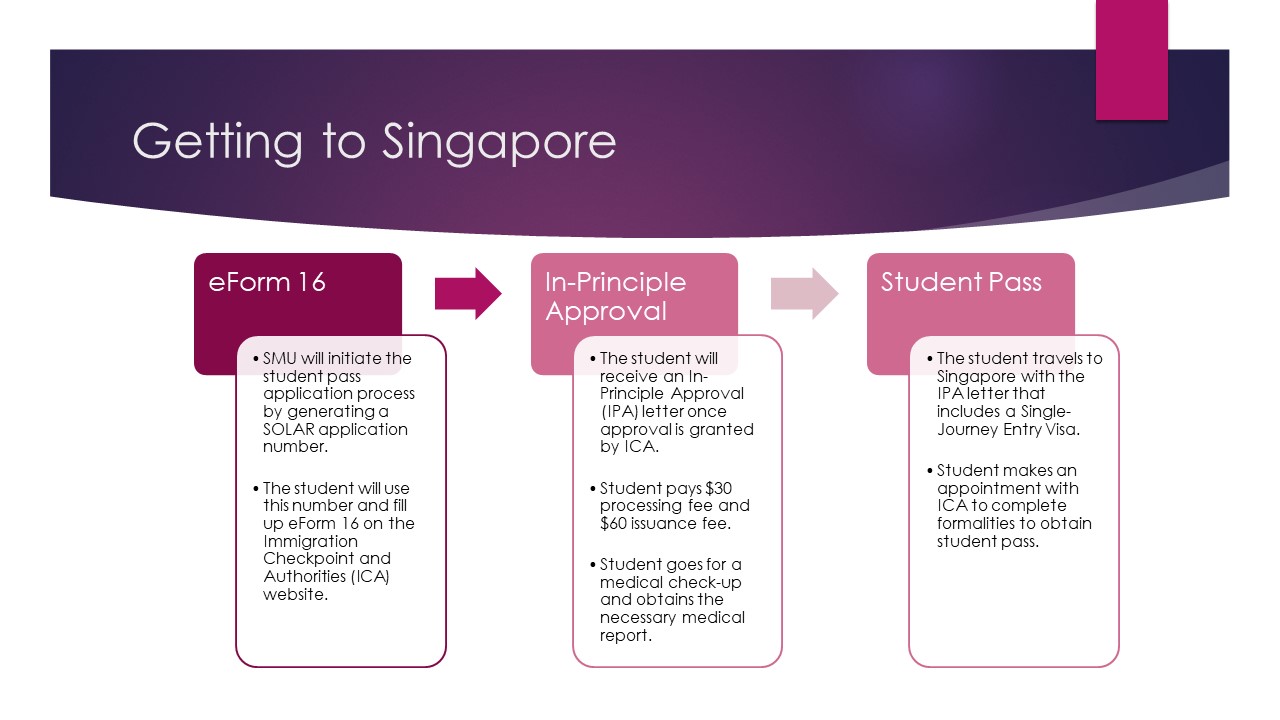
International students must possess a valid Student's Pass to be able to study at SMU. SMU will assist in the application of student passes once the offer to the programme is accepted. Under the Immigration Checkpoint and Authorities (ICA) regulations, only international students studying in a full-time programme are allowed to have student passes.
Application for Student's Pass is done online at the ICA website. You must receive a SOLAR application number from SMU before you can submit your application online. Your programme manager will usually initiate the application process in late May/early June. You will be provided with further details after the programme manager has registered you in SOLAR.
Student's Pass applications submitted electronically are generally processed in 5 working days for foreigners who do not require a visa to enter Singapore. For foreigners who require a visa to enter Singapore, the general processing time is 10 working days. Some applications may take a longer time to process.
For students who require visas to enter Singapore, the Student's Pass In-Principle Approval (IPA) letter will include a Single-Journey Entry Visa for your stay in Singapore till you have completed all formalities upon your arrival in Singapore. We will send the IPA letter via email once your Student's Pass application is approved. You can use the letter as a visa to enter Singapore. You are not required to apply for a separate visa.
If you wish to visit Singapore for personal reasons, please refer to the ICA website for a list of countries whose nationals require visas to enter Singapore.
Upon completion of the programme, students will have to give up their student passes. Extension of the student pass is not allowed once a student has completed graduation requirements.
Please note that the University does not sponsor the student's dependents (e.g. spouse, children, parents) for any immigration passes.
For details on student pass, please click here.
Private Apartments
You can engage the services of a property agent to help you find an apartment. There will be an agent's fee for this service.
Points to Consider When Choosing Accommodation:
Do note that the contract / tenancy agreement will be made solely between the student and hostel management / owner. Please read the contract / tenancy agreement carefully before you make any commitment.
Singapore has one of the highest cost of living in South East Asia. Below are estimates of how much is required during your stay in Singapore. They do not include tuition fees and travel expenses from your home country to Singapore.
An international student in Singapore spends, on average, about S$1,000 to S$3,000 a month on living expenses. This amount will, of course, vary depending on your lifestyle and course of study.
This table gives a rough estimate of basic monthly expenditure for an international student in Singapore:
| Item | Cost per Month (SGD) | Comments |
|
Accommodation |
$500 - $2000 |
Rental varies with geographical area, type of accommodation, demand, facilities provided & the number of people sharing, etc |
|
Utilities (including water and electricity) |
$40 - $100 |
|
|
Food |
$300 - $500 |
Based on $10-$15 per day for 3 meals at a foodcourt. |
|
Transportation |
$100 |
Depends on the distance and mode of transport. |
|
Telecommunications |
$50 |
Varies with usage and promotional packages subscribed for telephone services, mobile services and internet access services. |
|
Books & Stationery |
From $100/term |
Booklink at the SMU concourse stocks almost all the required textbooks. |
|
Personal Expenses |
$100 - $300 |
Varies with the individual. Could include expenses on clothes, toiletries, entertainment, haircut, miscellaneous. |
|
Medical Insurance |
|
As a SMU student, you are automatically entitled to SMU Medical Insurance Coverage scheme that covers your basic medical treatment and consultation. |
| Item | Cost per Month (SGD) | Comments |
|
Accommodation |
$500 - $2000 |
Rental varies with geographical area, type of accommodation, demand, facilities provided & the number of people sharing, etc |
|
Utilities (including water and electricity) |
$40 - $100 |
|
|
Food |
$300 - $500 |
Based on $10-$15 per day for 3 meals at a foodcourt. |
|
Transportation |
$100 |
Depends on the distance and mode of transport. |
|
Telecommunications |
$50 |
Varies with usage and promotional packages subscribed for telephone services, mobile services and internet access services. |
|
Books & Stationery |
From $100/term |
Booklink at the SMU concourse stocks almost all the required textbooks. |
|
Personal Expenses |
$100 - $300 |
Varies with the individual. Could include expenses on clothes, toiletries, entertainment, haircut, miscellaneous. |
|
Medical Insurance |
|
As a SMU student, you are automatically entitled to SMU Medical Insurance Coverage scheme that covers your basic medical treatment and consultation. |
For more information on living in Singapore, please click here.
Please click here for more details on SMU Medical Insurance Coverage Scheme.
| JUDICIAL STUDIES TRACK | CROSS-BORDER BUSINESS AND FINANCE LAW IN ASIA TRACK | LAW AND TECHNOLOGY TRACK | DUAL LLM IN COMMERCIAL LAW (SINGAPORE & LONDON) TRACK | |
|
Entry Requirements |
Good first degree in Law (LL.B. or J.D. or their equivalent). Significant relevant experience in legal or judicial positions is required. |
Good first degree in Law (LL.B. or J.D. or their equivalent). Non-law graduates may be considered on the basis of substantial relevant professional experience in law-related positions. |
||
|
English Language Proficiency |
Proof of English language proficiency is required for all international applicants except those from English-medium institutions in Australia, Canada, Hong Kong, Ireland, New Zealand, Philippines, United Kingdom and the United States. The minimum English proficiency test requirement is as follows:
Test scores are valid for two (2) years from the test date and applicants should ensure their scores remain valid at the beginning of the application period of for the LL.M track applied for. Applicants intending to take the proficiency test are advised to schedule their test sufficiently early to ensure that their score reports are avaliable before the closing date for the submission of supporting documents. Only official score reports are accepted. |
|||
|
JUDICIAL STUDIES TRACK |
CROSS-BORDER BUSINESS AND FINANCE LAW IN ASIA TRACK |
LAW AND TECHNOLOGY TRACK |
DUAL LLM IN COMMERCIAL LAW (SINGAPORE & LONDON) TRACK |
|
|
Entry Requirements |
Good first degree in Law (LL.B. or J.D. or their equivalent). Significant relevant experience in legal or judicial positions is required. |
Good first degree in Law (LL.B. or J.D. or their equivalent). Non-law graduates may be considered on the basis of substantial relevant professional experience in law-related positions. |
||
|
English Language Proficiency |
Proof of English language proficiency is required for all international applicants except those from English-medium institutions in Australia, Canada, Hong Kong, Ireland, New Zealand, Philippines, United Kingdom and the United States. The minimum English proficiency test requirement is as follows:
Test scores are valid for two (2) years from the test date and applicants should ensure their scores remain valid at the beginning of the application period of for the LL.M track applied for. Applicants intending to take the proficiency test are advised to schedule their test sufficiently early to ensure that their score reports are avaliable before the closing date for the submission of supporting documents. Only official score reports are accepted. |
|||
| Application Fee (non-refundable) | Registration Fee (non-refundable) | Fee | |
|
Law and Technology Track together with Judicial Studies Track and Cross-Border Business and Finance Law in Asia Track |
S$100 (inclusive of GST) |
Singaporeans/SPR: S$400* w/GST |
S$37,450 (inclusive of GST) 1st billing is payable in August: S$16,225 2nd billing is payable in December: S$16,225 |
|
Judical Studes Track |
|||
|
Cross-border Business and Finance Law in Asia Track |
|||
|
Dual LLM in Commercial Law (Singapore & London) Track |
Applicants shortlisted by QMUL will be required to pay to SMU an application fee of S$100 (inclusive of GST) |
The tuition fees are: |
|
Application Fee (non-refundable) |
Registration Fee (non-refundable) |
Fee |
|
|
Law and Technology Track together with Judicial Studies Track and Cross-Border Business and Finance Law in Asia Track |
S$100 (inclusive of GST) |
Singaporeans/SPR: S$400* w/GST |
S$37,450 (inclusive of GST) 1st billing is payable in August: S$16,225 2nd billing is payable in December: S$16,225 |
|
Judical Studes Track |
|||
|
Cross-border Business and Finance Law in Asia Track |
|||
|
Dual LLM in Commercial Law (Singapore & London) Track |
Applicants shortlisted by QMUL will be required to pay to SMU an application fee of S$100 (inclusive of GST) |
The tuition fees are: |
Please note that there will not be any government subsidy for the LL.M. programme, e.g. MOE Tuition Grant, Service Obligation Scheme. All applicants will have to be self-funded.
*Goods and Services Tax (GST) is a tax collected on behalf of the Singapore Government and will be charged at the prevailing rate.
The PGPP-ASEAN Scholarship, funded by SMU Office of Postgraduate Professional Programmes (PGPP), aims to develop top ASEAN legal talents. The scholarship co-funds outstanding individuals in their pursuit of the SMU LLM / Dual LLM programme.
Eligibility
Tenure & Benefits of the Local Postgraduate Scholarship Award
Tenure & Benefits of the Scholarship
Eligibility
The Fangda Partners Scholarship is meant to motivate outstanding candidates who are enrolled on the SMU YPHSL LLM in Law and Technology track, and to spur them on to greater heights of academic excellence and accord appropriate recognition to the recipients of the scholarship for their accomplishments. Tenure & Benefits of the Scholarship
Eligibility
The Jones Day Foundation has graciously decided to fund up to four Jones Day Master of Laws in Judicial Studies Scholarships for outstanding candidates enrolled in this programme at the SMU Yong Pung How School of Law, starting in AY 2020/2021. This scholarship demonstrates the Jones Day Foundation’s commitment to enhancing the rule of law by increasing the competency of judges and standing of judiciary in the region.
Eligibility
Candidates must:
Interested candidates can apply once they have received the offer to take up the LLM (Judicial Studies) degree at the SMU Yong Pung How School of Law. In support of your application, you must provide a personal statement of between 500 and 1,000 words, alongside documentation that proves financial need, if applicable. In the personal statement, you may wish to highlight the anticipated impact of the degree on your current or future career, the reasons for your interest in the degree as well as any noteworthy personal or professional achievements to date. Short-listed candidates may be interviewed. The School will make a good faith effort to ensure that the available scholarships will benefit a diverse range of meritorious candidates, with reference to such factors as gender, cultural background, national origin, socio-economic background and financial need.
Tenure & Benefits of the Jones Day Master of Laws (Judicial Studies) Scholarship:
Notes and exclusions:
* Matriculated candidates who opt to defer their admission offer or studies will not be able
to carry forward the scholarship.
* Candidates cannot simultaneously hold any other scholarships.
The best performing graduate of the LLM in Judicial Studies will receive the Jones Day Top Scholar Award, awarded by the Yong Pung How School of Law once per annum.
Each award has a monetary value of S$10,000 (inclusive of GST).
The Top Scholar Award will be presented to the winner during the SMU Convocation Ceremony or another appropriate University event.
The Lee Foundation has graciously decided to make available up to six annual Lee Kong Chian Master of Laws (Judicial Studies) Scholarships for outstanding candidates enrolled in this programme at the SMU Yong Pung How School of Law. The scholarships are intended to off-set the tuition fees charged for the LLM (Judicial Studies) and cannot be used to defray living expenses. Up to six scholarships will be awarded each year to up to four Singapore citizens or permanent residents and up to two international candidates. Each scholarship is tenable for the full duration of the scholar’s studies, subject to continued observance of the eligibility criteria.
Eligibility
Candidates must:
Special consideration may be given to candidates who demonstrate financial need, in particular those from non-OECD countries.
Interested candidates can apply once they have received and accepted the offer to take up the LLM (Judicial Studies) degree at the SMU Yong Pung How School of Law. In support of your application, you must provide a personal statement of between 500 and 1,000 words, alongside documentation that proves financial need, if applicable. In the personal statement, you may wish to highlight the anticipated impact of the degree on your current or future career, the reasons for your interest in the degree as well as any noteworthy personal or professional achievements to date. Short-listed candidates may be interviewed.
Tenure & Benefits of the Lee Kong Chian Master of Laws (Judicial Studies) Scholarship:
Notes and exclusions:
* Matriculated candidates who opt to defer their admission offer or studies will not be able
to carry forward the scholarship.
* Candidates cannot simultaneously hold any other scholarships.
SMU undergraduate and postgraduate alumni who are offered a place in the LL.M. programme will automatically be granted a 10% discount of the LL.M. tuition fee. The 10% discount will be spread equally over the two payment instalment periods. SMU exchange and non-graduating students are not eligible for the alumni discount.

The LLM is not a qualifying law degree in Singapore. Should you wish to qualify for the Singapore Bar, please apply for the 3-year full-time Juris Doctor Programme (JD) instead. A qualified foreign lawyer may become a Registered Foreign Lawyer, or take the Foreign Practitioner Examination administered by the Singapore Institute of Legal Education.
No, LLM classes are exclusive to postgraduate students.
As the content and approach in courses vary widely from institution to institution, the policy is not to grant exemptions or credit transfers.
Yes. Applicants can seek to audit selected courses in the programme. More details on auditing the LLM can be found here.
Yes, core LLM modules are accredited by the Singapore Institute of Legal Education and fulfil the mandatory Continuing Professional Development (CPD) requirements.
The LLM requires a basic law degree. However, those with substantive knowledge of the law may be considered on an individual basis. In the past, candidates with substantial experience in accounting firms and regulatory bodies such as the Monetary Authority of Singapore have been admitted into the programme.
No, you do not. If your postgraduate degree is from English-medium institutions in Australia, Canada, Hong Kong, Ireland, New Zealand, Philippines, United Kingdom and the United States, you do not need to take the English proficency test.
As a SMU full-time matriculated international student holding a valid student pass, you may take up employment in Singapore during the vacation and are exempted from applying for a work permit as stated in the Work Permit Exemptions Notification. However, during the term time, a student holding a valid student pass is only allowed to work part-time of less than 16 hours per week. A letter of consent is not required from the Immigration and Checkpoints Authority of Singapore or the university.
For more information, please refer to MOM-Employment of Foreign Students.
